
The Politicization of ALPR Data: Privacy, Records & Investigations
June 2nd, 2026
Introduction
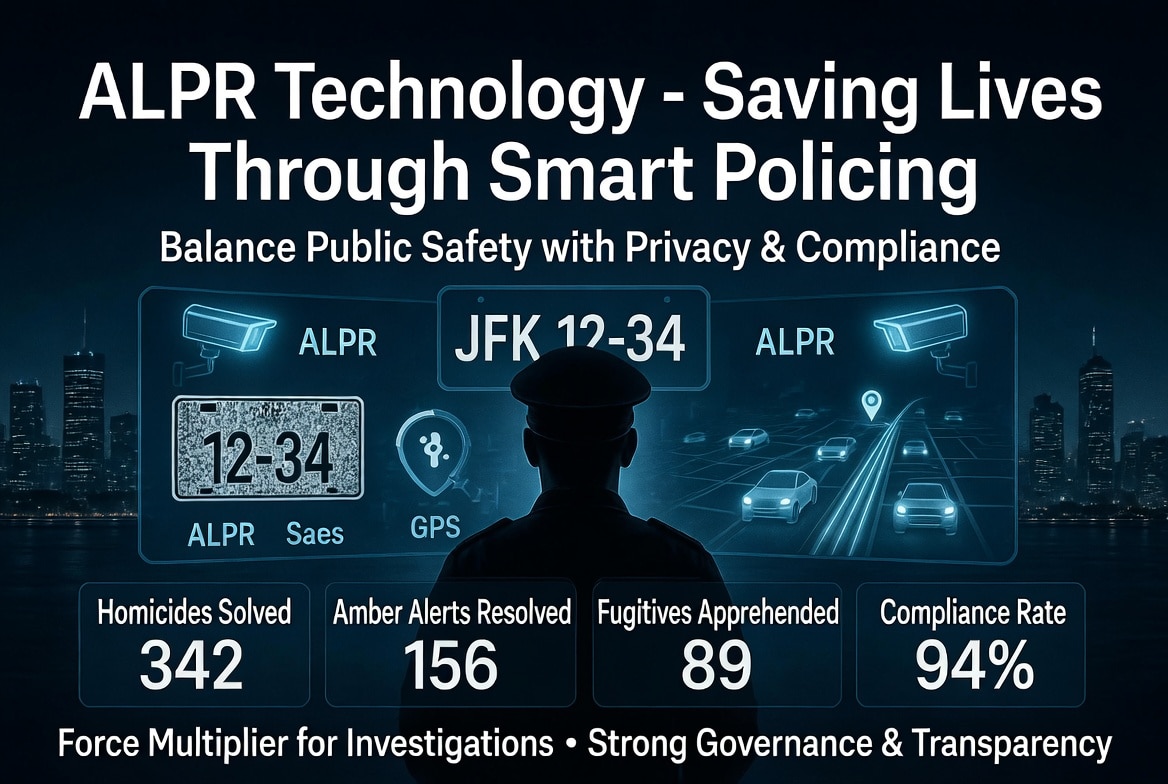
Automated License Plate Recognition (ALPR) technology has rapidly become one of the most powerful tools available to modern law enforcement. By capturing, storing, and analyzing license plate data, agencies can identify stolen vehicles, locate missing persons, connect suspects to crimes, and disrupt violent criminal activity with a speed and scale that was previously impossible.
Yet as ALPR has grown in effectiveness, it has also become a flashpoint in broader political and legal debates. At the center of these debates is a fundamental tension: how do we harness the undeniable public-safety benefits of ALPR data while honoring privacy rights and compliance with public records laws which are inherently designed to promote transparency?
ALPR as a Force Multiplier for Public Safety
There is no serious dispute that ALPR data saves time—and lives. In investigations involving homicides, armed robberies, human trafficking, and Amber Alerts, ALPR hits can provide crucial leads within minutes. For investigators, ALPR is not about passive surveillance; it is about pattern recognition, corroboration, and accountability. It allows agencies to work smarter, not broader, by narrowing investigative focus to relevant vehicles and timelines.
When used properly, ALPR data reduces reliance on less precise methods, minimizes officer guesswork, and can even reduce unnecessary stops by confirming or excluding vehicles of interest before contact is made.
Privacy Rights and Data Protection Laws
At the same time, ALPR data inherently involves information about the movements of everyday people—most of whom are not suspects in any crime. This reality has driven the development of data privacy laws and agency policies governing retention limits, access controls, auditing, and permissible use.
These laws and policies should not be obstacles to law enforcement; they should be safeguards. Data protection statutes exist to ensure that sensitive information is collected lawfully, used narrowly, retained only as long as necessary, and protected from misuse.
Strong governance frameworks help maintain public trust by demonstrating that agencies take privacy seriously and recognize the responsibility that comes with powerful technology.
Public Records Laws and the Transparency Mandate
Complicating matters further are public records laws, which serve a different—but equally important—public interest: transparency. These laws are designed to ensure accountability in government operations and allow the public to understand how tools like ALPR are being deployed.
However, transparency does not mean unrestricted disclosure. Public records/FOIA statutes often include exemptions for active investigations, sensitive law enforcement techniques, and personal privacy. Records professionals play a critical role in navigating these exemptions—balancing the public’s right to know with the need to protect investigations and individual privacy.
From a records management standpoint, ALPR data occupies a unique category. It is:
- Digitally generated at high volume
- Often retained for limited periods
- Subject to statutory use, access, and disclosure restrictions
- Requested under public records laws
Best practices for records managers include:
- Clearly defining ALPR data retention periods consistent with state law
- Ensuring ALPR access logs are retained as required and auditable
- Coordinating closely with legal counsel on public records requests
- Verifying that vendor agreements align with statutory sharing limits
- Documenting the purpose and authority for all inter-agency data access
As ALPR laws evolve, records managers play a critical role in ensuring agencies remain compliant without undermining investigative effectiveness.
The Risk of Politicization
s ALPR becomes a frequent subject of public debate, there is a selfish, politically-driven narrative by politicians around what are nuanced legal and operational decisions, resulting in political talking points. Oversimplifying ALPR as either “mass surveillance” or “unchecked policing” ignores the careful policy work already being done by agencies, attorneys, and records managers to strike a lawful balance.
Politicization can lead to blanket bans, reactionary legislation, or inconsistent guidance that ultimately harms both public safety and civil liberties. Effective governance requires sober analysis, not slogans or knee-jerk reactions.
Real-World Impact: ALPR Data and Violent Crime Investigations
The value of ALPR data is not theoretical—it has repeatedly played a decisive role in violent crime investigations.
Homicide Investigation (California):?
In Los Angeles County, investigators used ALPR technology to locate and arrest a suspect believed to be responsible for multiple homicides. The suspect’s vehicle was entered into an ALPR hot list, and when it was detected, the resulting location data allowed deputies to rapidly narrow their search and apprehend the suspect. Law enforcement officials stated that without ALPR data, the suspect may have remained at large, posing a continued threat to public safety.
Kidnapping Case (Texas):?
In a separate case, ALPR cameras detected a vehicle linked to an active child kidnapping shortly after an Amber Alert was issued. Plate-reader hits from multiple jurisdictions helped track the suspect’s route, leading officers to intercept the vehicle and safely recover the child within hours.
Armed Robbery and Fugitive Apprehension:?
ALPR data has also been used to locate armed robbery suspects and fugitives who crossed county and state lines. In several cases, suspects were apprehended after ALPR systems detected vehicles associated with violent crimes during routine patrol operations—alerts that would not have occurred without shared data access.
These cases illustrate a critical reality: violent offenders do not respect jurisdictional boundaries, and timely access to ALPR data can be the difference between a rapid arrest and a missed opportunity.
Multi-State Vehicle Tracking Leads to Arrest of Cop Killer
In one notable instance documented in law enforcement case summaries, Maricopa County (Arizona) investigators used ALPR data combined with historical license plate records to locate and arrest a suspect who had fled after killing a deputy. After a public plea helped identify a vehicle of interest, officers could not initially find a local address because the plates were registered in another state.
By leveraging ALPR systems and historical plate-tracking data, investigators were able to trace the vehicle’s movements and ultimately locate a local address where the suspect was apprehended.
Why ALPR Works Across Jurisdictions
ALPR systems don’t just record a license plate — they capture the time and GPS location of every hit, which can then be searched against “hot lists” or databases of vehicles linked to crimes. Agencies often share and query this data to determine when and where a suspect vehicle has been observed, even far from the original crime scene.
Because the NCIC system and other shared databases allow hot lists to be compared nationwide, an ALPR hit in one state can trigger investigative follow-up in another — a capability that has been used to track and recover vehicles and locate suspects in a range of serious criminal cases.
The Path Forward: Balance, Not Extremes
ALPR data does not exist in a legal vacuum. It sits at the intersection of privacy law, public records law, and criminal procedure—and that intersection is precisely where professional records management matters most. The goal is not to choose between safety and privacy, or transparency and investigations. The goal is balance:
- Clear policies that define appropriate use
- Strong access controls and audits to prevent misuse
- Reasoned application of public records exemptions
- Ongoing public communication about how data is governed
How To Learn More: Training
Register for our online class: Drone, ALPR, and Surveillance Records: What Can Be Released.
More than 42,000 public safety professionals have already gained the confidence and capability they need through PRI’s programs. The time to prepare is now—your success in 2026 and beyond starts with a single strategic decision.
 Find us on Google Maps